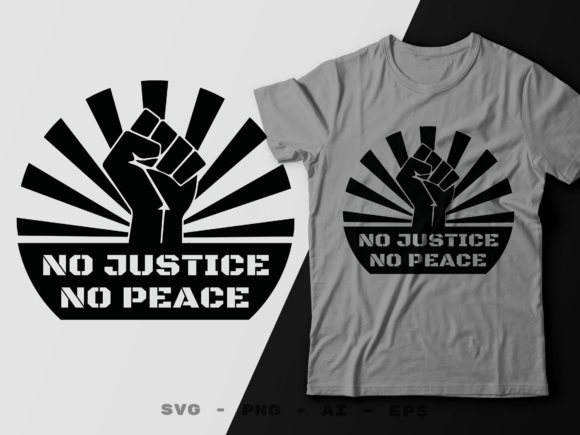
No Justice No Peace Quote Design: Graphics for Crafts & Causes
As a graphic designer who’s built brand identities for handmade businesses, curated social media visuals for activist-led campaigns, and developed printable design suites for Etsy sellers, I recently evaluated the No Justice No Peace Quote Design ahead of a client project—a limited-edition tote bag and poster series for a community-led racial justice initiative. My goal wasn’t just to see if it “looks good,” but whether it holds up as a commercial design asset—functional, flexible, and faithful to both message and medium.
First Impression: Raw, Resonant, and Visually Anchored
The No Justice No Peace Quote Design lands with immediate emotional weight. It’s not decorative—it’s declarative. The typography leans into bold, high-contrast letterforms, often with intentional texture or subtle distressing that evokes protest signage, screen-printed posters, and grassroots editorial design. There’s no frivolity here: spacing is tight but legible, kerning feels considered, and the rhythm of the phrase reinforces urgency without sacrificing clarity. It reads as modern design rooted in real-world visual language—not trend-chasing, but truth-telling.
Where It Shines in Real Client Work
This graphic design asset excels where authenticity and impact matter most:
- Product mockups for t-shirts, mugs, and tote bags—especially when paired with neutral, organic substrates (unbleached cotton, kraft paper, matte ceramic)
- Social media graphics for Instagram posts and Pinterest pins, where its strong silhouette and high-contrast rendering hold up even at thumbnail size
- Cricut projects and vinyl-cut stickers—thanks to clean vector paths in the included SVG and AI files
- Printable design collections for educators, organizers, or small business owners launching themed merchandise drops
- Packaging design accents—think stamped labels, belly bands, or interior sleeve text for ethically sourced goods
- Editorial design elements in zines, campaign toolkits, or digital newsletters where tone and consistency are non-negotiable
Because it ships as a DIGITAL FILE—with SVG, EPS, PNG, and AI formats in one ZIP—you’re not locked into a single use case. Need crisp scalability for a 48″ wide banner? Use the vector. Need transparent-layer flexibility for Canva templates or web overlays? The PNG delivers. That cross-format reliability makes it a smart addition to any design bundle meant for commercial reuse.
Where Caution Is Required
This isn’t a universal-fit clipart piece. Its strength is also its limitation: it carries unmistakable ideological and aesthetic gravity. Use it carefully in:
- Small sizes—below 1.5″ width, fine details like textured strokes or tight tracking can blur or collapse
- Crowded layouts—it demands breathing room; pair it with generous negative space, not dense iconography or layered patterns
- Minimalist branding systems—if your client’s identity relies on ultra-clean sans serif typography and restrained color palettes, this design may clash rather than complement
- Corporate or B2B contexts—unless the brand is explicitly mission-driven and socially engaged, its tone can feel incongruent with traditional professionalism
Design Judgment: Readability, Hierarchy & Trust
Readability is solid at mid-to-large sizes—but test it rigorously. I placed the No Justice No Peace Quote Design over five background tones (off-white, charcoal, sage, rust, and deep navy) and found optimal contrast only on light neutrals and true darks. On mid-tone backgrounds, the PNG’s transparency helped, but the SVG required manual fill adjustments.
Hierarchy works best when this quote is the sole focal point—or supported by minimal secondary text (e.g., an organization name in a clean sans serif). It doesn’t play well as a subheading or caption. As part of a broader brand identity, it functions powerfully as a campaign anchor, not a logo replacement.
Visually, it builds trust through consistency of intent—not polish alone, but purposeful execution. For audiences aligned with its values, it signals authenticity. For designers, it signals craft: the vector paths are smooth, anchors are properly placed, and the AI file retains editable layers. That attention matters when building print-on-demand assets or scaling for sublimation design.
Practical Designer Notes Before You Deploy
Before dropping this into a client deliverable, run these checks:
- Test in black and white—many print partners convert to grayscale; verify legibility without color support
- Preview at actual size on product mockups—not just in Illustrator, but on a Cricut preview screen, Canva template, or printed proof
- Inspect PNG transparency—ensure no stray pixels or anti-aliased halos compromise clean edges on dark backgrounds
- Compare font pairings—try it beside Montserrat, Playfair Display, and even handwritten fonts to gauge tonal harmony
- Verify commercial license terms—this is a digital product intended for resale in end products (totes, prints, apparel), but always confirm permitted uses before licensing for an Etsy product or client-branded campaign
Final Verdict: A Focused, High-Value Creative Asset
The No Justice No Peace Quote Design isn’t background decor—it’s a statement tool. In the hands of designers serving handmade business owners, small business branding clients, or mission-driven publishers, it adds gravitas, cohesion, and cultural resonance. It performs reliably across SVG design, sticker design, web design, and marketing visuals—as long as you honor its voice, scale it thoughtfully, and embed it within intentional visual systems.
For the community initiative I’m supporting? It became the central motif across all touchpoints—refined in layout, anchored in message, and elevated by smart file use. That’s the mark of a truly functional creative design: not just what it looks like, but how it works—quietly, powerfully, and without compromise.